The rapid evolution of artificial intelligence (AI) has introduced powerful tools like machine learning (ML) and deep learning (DL). While both technologies drive innovation, choosing the right one for your project can be challenging. This article breaks down their differences, strengths, weaknesses, and ideal use cases to help you make an informed decision. Whether you’re building a recommendation engine or a self-driving car, understanding these technologies is critical to aligning your project with the best possible solution.
Understanding the Basics
What is Machine Learning?
Machine learning is a subset of AI that enables systems to learn patterns from data without explicit programming. It uses algorithms to analyze data, identify trends, and make predictions. ML models improve over time as they process more information.
Types of Machine Learning:
- Supervised Learning: Trained on labeled data (e.g., spam detection).
- Unsupervised Learning: Discovers patterns in unlabeled data (e.g., customer segmentation).
- Reinforcement Learning: Learns through trial and error using rewards/punishments (e.g., game-playing AI).
What is Deep Learning?
Deep learning is a specialized branch of ML that mimics the human brain’s neural networks. It uses artificial neural networks (ANNs) with multiple layers (“deep” architectures) to process complex data like images, audio, and text.
Key Architectures:
- Convolutional Neural Networks (CNNs): Ideal for image processing.
- Recurrent Neural Networks (RNNs): Suited for sequential data (e.g., time series, language).
- Transformers: Power modern natural language processing (NLP) systems like ChatGPT.
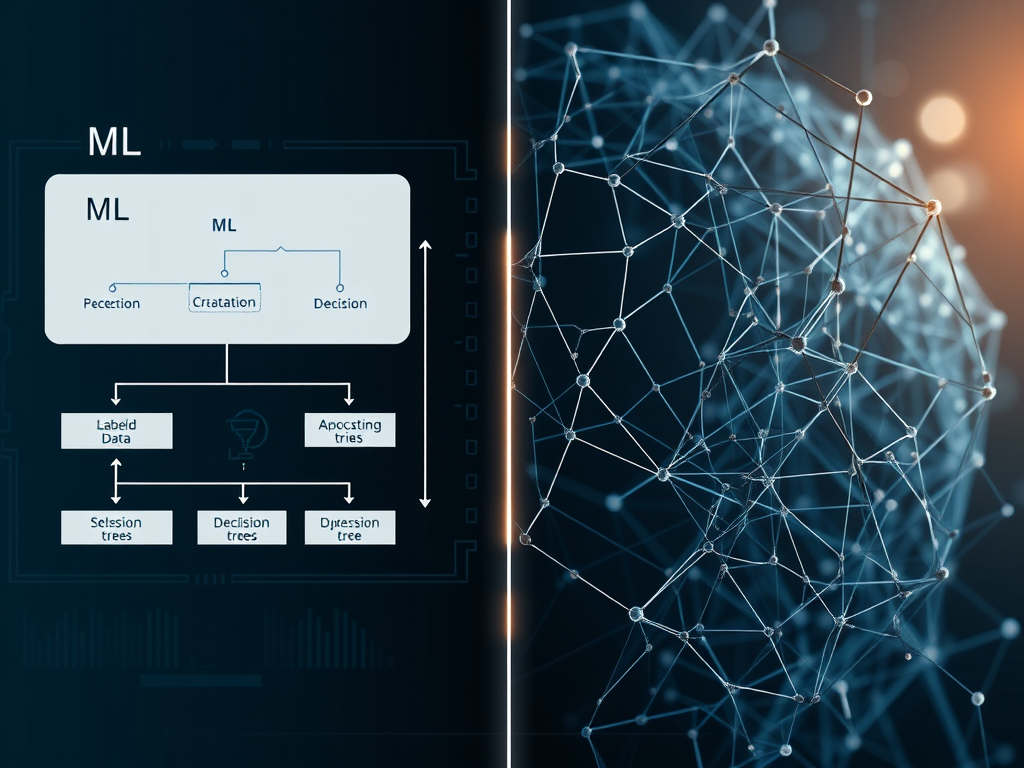
Key Differences Between ML and DL
| Factor | Machine Learning | Deep Learning |
|---|---|---|
| Data Requirements | Works with small to medium datasets | Requires massive datasets |
| Feature Engineering | Manual feature extraction needed | Automatic feature learning |
| Computational Power | Runs on CPUs | Needs GPUs/TPUs for training |
| Interpretability | Transparent decision-making | “Black box” complexity |
| Use Cases | Structured data, simpler tasks | Unstructured data, complex tasks |
Strengths and Weaknesses
Machine Learning
Strengths:
- Efficiency: Faster training on smaller datasets.
- Interpretability: Clear logic (e.g., decision trees).
- Resource-Friendly: Runs on standard hardware.
Weaknesses:
- Limited Complexity: Struggles with unstructured data.
- Manual Feature Engineering: Time-consuming and expertise-heavy.
Deep Learning
Strengths:
- High Accuracy: Excels in complex tasks (e.g., image recognition).
- Automation: Learns features directly from raw data.
- Scalability: Improves with more data and layers.
Weaknesses:
- Data Hunger: Requires thousands of labeled examples.
- Hardware Costs: Demands expensive GPUs/cloud resources.
- Opacity: Difficult to debug or explain decisions.
Use Cases: Where Each Shines
Machine Learning Applications
- Fraud Detection: Identifying anomalies in transactional data.
- Customer Churn Prediction: Analyzing structured CRM data.
- Predictive Maintenance: Forecasting equipment failures.
Deep Learning Applications
- Computer Vision: Facial recognition, medical imaging.
- Natural Language Processing (NLP): Chatbots, sentiment analysis.
- Autonomous Vehicles: Real-time object detection and decision-making.
Assessing Your Project Requirements
Ask these questions to determine the right fit:
- Data Availability: Do you have labeled, large-scale datasets?
- Problem Complexity: Are you dealing with images, audio, or text?
- Resources: Can you access GPUs and cloud infrastructure?
- Interpretability: Do stakeholders require transparent models?
Decision Workflow:
- Choose ML if: Limited data, need speed/transparency, or structured data.
- Choose DL if: Complex unstructured data, high accuracy is critical, and resources are available.
Tools and Frameworks
Machine Learning Tools
- Scikit-learn: For classic algorithms (regression, clustering).
- XGBoost: Optimized for gradient-boosted decision trees.
- Google AutoML: Automated model training for non-experts.
Deep Learning Frameworks
- TensorFlow/PyTorch: Flexible libraries for building neural networks.
- Keras: Simplified interface for rapid prototyping.
- Hugging Face: Pre-trained models for NLP tasks.
Future Trends in ML and DL
- AutoML: Democratizing ML with automated pipelines.
- Edge AI: Deploying lightweight DL models on IoT devices.
- Ethical AI: Demanding interpretability and fairness in models.
- Quantum Machine Learning: Solving intractable problems with quantum computing.
Conclusion
Machine learning and deep learning are complementary tools, not competitors. While ML suits projects with limited data and a need for transparency, DL unlocks unparalleled accuracy for complex tasks. At Code of the Future, aligning your project’s goals, data, and resources with the right technology will ensure efficiency and innovation.
FAQs
Q1: Can ML and DL be used together?
Yes! Hybrid models (e.g., using ML for post-processing DL outputs) are common.
Q2: Is deep learning always better than machine learning?
No—DL is overkill for simple tasks. Always match the tool to the problem.
Q3: How much data does deep learning need?
Typically thousands to millions of samples, but transfer learning reduces this.
Q4: Which is easier to implement for beginners?
Start with ML (scikit-learn) before diving into DL frameworks.


Leave a comment